
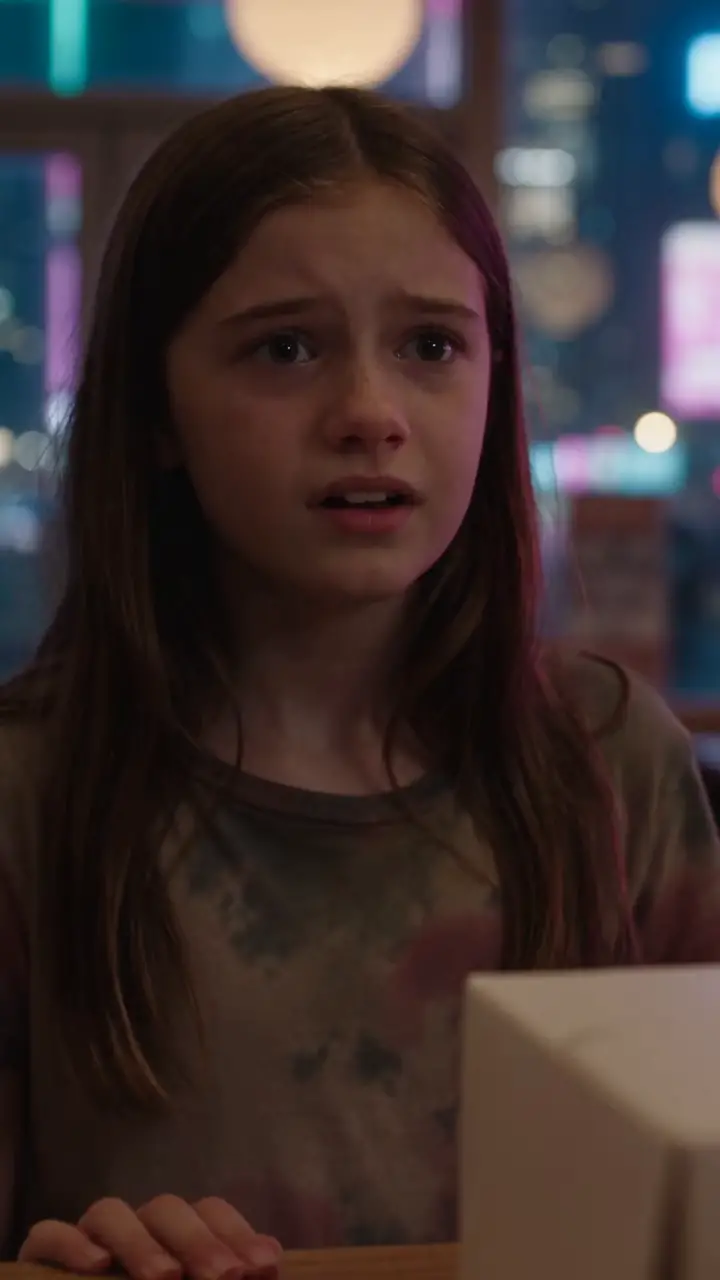
Part 1 — The Cake Nobody Wanted
At 4:47 on a wet Thursday afternoon, Jennifer Cole was wiping strawberry frosting from a stainless-steel counter when she heard a girl ask whether the bakery was really going to throw the cake away.
The question was so quiet Jennifer almost missed it.
Maple Street Bakery closed at five. Most of the display case had already been emptied. Mae, the owner, was carrying an unclaimed six-inch strawberry cake toward the kitchen when the girl spoke.
“Are you throwing that away?”
Mae stopped.
Jennifer looked toward the voice.
The girl stood alone on the customer side of the counter.
Thirteen, maybe.
A gray hoodie hung loosely from narrow shoulders. Her canvas backpack had been repaired at one corner with black thread. She had rain on her hair and the cautious posture of someone who had learned not to assume that adults wanted her around.
Jennifer stepped closer.
“Why?”
The girl immediately looked embarrassed.
“I was just asking.”
“That’s okay.”
For a moment she said nothing.
Then:
“Tomorrow’s my birthday.”
Jennifer smiled automatically.
“Happy early birthday.”
The girl nodded.
“My foster family doesn’t really do birthdays.”
She said it casually.
That was what made Jennifer’s smile disappear.
Not bitterly.
Not dramatically.
Just as if she were explaining that the bus came every thirty minutes.
Mae looked at Jennifer.
Jennifer looked at the little cake.
“Box it.”
The girl straightened.
“No, I don’t have money.”
“I didn’t ask you for money.”
“I wasn’t trying to get something free.”
“I know.”
Jennifer came around the counter and took a clean cake box from the shelf.
She placed the strawberry cake inside.
The frosting was imperfect where the original customer’s name had been removed, but the rest of it was untouched.
Jennifer folded the cardboard carefully.
The girl watched every movement.
When Jennifer pushed the box toward her, the girl rested both hands on it.
“Really?”
“Really.”
“Thank you.”
“You’re welcome.”
The girl gave a small smile.
That was when Jennifer noticed the front tooth.
Slightly turned inward.
Her stomach tightened.
It was nothing.
Children had crooked teeth.
Thousands of them.
Jennifer told herself not to stare.
Instead she asked:
“How old will you be?”
“Thirteen.”
Jennifer’s hand stopped on the counter.
Ruby would have been thirteen tomorrow.
No.
Not tomorrow.
Ruby was thirteen tomorrow.
Jennifer had forced herself years ago to stop speaking about her daughter in the past tense.
She swallowed.
“What’s your birthday?”
“September fourth.”
The bakery seemed to lose its sound.
Jennifer could still see Mae moving behind the counter.
Cars still crossed the wet intersection outside.
The refrigerator still hummed.
But Jennifer heard none of it.
September fourth.
Thirteen.
Jennifer stared at the girl.
Dark blond hair.
Hazel-green eyes.
Narrow chin.
A slight inward turn of the right front tooth.
She knew what desperation could do to a person.
Six years earlier, Jennifer had thought she saw Ruby at a gas station in Ohio.
The child had been blonde and about the right age.
Jennifer had followed that family into the parking lot before the girl’s mother screamed at her.
Another time she had driven three hours because somebody posted a photograph of a child at a county fair who looked like Ruby from behind.
She had learned.
A resemblance was not evidence.
A birthday was not evidence.
Hope could become cruel if you allowed it to make decisions.
Jennifer forced herself to breathe.
“What’s your name?”
“Rebecca.”
“Rebecca what?”
The girl hesitated.
“Stone.”
Jennifer nodded slowly.
She should stop.
She knew she should.
Then she heard herself ask:
“Did you ever have another name?”
Rebecca’s expression changed instantly.
“How do you know that?”
Jennifer’s heart began hammering.
“I don’t.”
Rebecca took one step back.
Jennifer immediately lifted both hands.
“I’m sorry. I shouldn’t have asked you like that.”
Rebecca looked toward the door.
Mae had stopped working.
Nobody moved.
Jennifer said softly:
“You don’t have to answer me.”
Rebecca stared at her for several seconds.
Then she looked down at the cake.
“When I was little,” she said, “I think people called me Ruby.”
Jennifer stopped breathing.
Rebecca continued quickly, perhaps regretting the admission.
“I don’t really remember. It might’ve been a nickname.”
Jennifer gripped the edge of the counter.
“Ruby Cole is my daughter.”
Rebecca looked up.
Jennifer knew the sentence had come too quickly.
She knew it even as she said it.
She corrected herself.
“My daughter disappeared six years ago. Her name is Ruby Cole. She was seven.”
Rebecca’s face emptied of expression.
Jennifer did not step closer.
Rebecca whispered:
“I was seven.”
Mae quietly moved toward the front door and turned the lock.
Jennifer’s eyes filled.
Rebecca looked frightened now.
“My foster family said nobody ever came looking for me.”
Jennifer’s voice almost failed.
“I still buy a cake every September fourth.”
Rebecca stared at her.
Jennifer had imagined finding Ruby a thousand different ways.
At a police station.
At an airport.
In a hospital.
Walking through a school parking lot.
Running into her arms.
Calling her Mom.
None of those fantasies looked like this.
A thirteen-year-old stranger stood three feet away holding a cake nobody wanted.
And Jennifer was suddenly terrified that if she moved even an inch, the girl would disappear again.
Part 2 — The Woman Who Came to Get Rebecca
Rebecca’s foster mother arrived eighteen minutes later.
Her name was Dana Harris.
She was forty-eight and still wearing navy hospital scrubs beneath a rain jacket. She entered the locked bakery already looking worried.
“Rebecca?”
“I’m okay.”
Dana crossed the room but did not touch her.
Then Rebecca said:
“This woman thinks I’m her daughter.”
Dana looked at Jennifer.
Jennifer saw something in her face.
Not disbelief.
Concern.
The kind that suggested this was not the first strange thing attached to Rebecca’s history.
Jennifer explained as calmly as she could.
“My daughter disappeared six years ago. She would turn thirteen tomorrow. Her birthday is September fourth. Rebecca told me she remembers being called Ruby.”
Dana closed her eyes briefly.
“What?”
Rebecca looked at her.
“You knew something was wrong.”
“No.”
“You made that face.”
Dana pulled out a chair.
“Sit down.”
“I don’t want to sit down.”
“Okay.”
Dana remained standing too.
Jennifer respected that.
Dana asked:
“Do you have a missing-child case number?”
Jennifer answered immediately.
“NCIC file ending 4172. Original report through Millbrook Police, September third, six years ago.”
Rebecca flinched.
“September third?”
Jennifer looked at her.
“Yes.”
“The day before my birthday?”
“Yes.”
Rebecca’s hands tightened around the cake box.
Jennifer realized what she had just done.
She had dropped another piece of information into a child’s life before anyone was prepared to hold it.
“I’m sorry.”
“Why do you keep saying sorry?”
“Because I don’t want to tell you what your life is before we know.”
Rebecca stared at her.
“That’s what everybody does.”
Jennifer had no answer.
Dana stepped away and called Rebecca’s caseworker.
While they waited, Jennifer stayed behind the counter.
She did not ask Rebecca to show birthmarks.
She did not ask for childhood memories.
She did not touch her.
Rebecca sat at a corner table with the cake in front of her.
Ten minutes passed.
Then she asked:
“What kind?”
Jennifer looked over.
“What?”
“The cakes.”
Jennifer knew immediately.
“Strawberry.”
Rebecca looked down.
“All of them?”
“Yes.”
“Why strawberry?”
Jennifer’s throat tightened.
“You hated chocolate cake.”
Rebecca frowned.
“I hate chocolate cake.”
Jennifer almost laughed.
Instead tears came.
She wiped them away quickly.
Rebecca looked uncomfortable.
Jennifer said:
“That still doesn’t prove anything.”
Rebecca looked surprised.
“You keep saying that.”
“Because I need you to hear it.”
“What if I am her?”
Jennifer looked at the girl she desperately wanted to call her daughter.
“Then we’ll find out.”
“And if I’m not?”
“Then I bought a thirteen-year-old a birthday cake.”
Rebecca stared.
Something in her shoulders softened.
Not much.
But enough.
Her caseworker, Lila Morgan, arrived shortly after six.
Lila listened to the entire story twice.
Then she asked Dana and Rebecca a question Jennifer did not understand.
“Did the records request from Missouri come back?”
Dana shook her head.
“Not yet.”
Jennifer looked between them.
“What records?”
Lila hesitated.
She was careful.
Jennifer appreciated that too.
“Rebecca’s early documentation has inconsistencies.”
Rebecca’s face hardened.
“You said it was paperwork.”
“It is paperwork.”
“What kind?”
Lila pulled out a chair.
“The birth certificate in your file was registered late.”
“So?”
“The clinic listed on some of your vaccination records wasn’t operating on the dates shown.”
Rebecca stared at her.
“What are you saying?”
“I’m saying we were already verifying your early records before today.”
Jennifer felt cold.
Lila turned to her.
“We need to contact law enforcement.”
Jennifer nodded.
Rebecca said suddenly:
“I have school tomorrow.”
Everyone looked at her.
“It’s my birthday. I have a math test.”
Dana almost smiled.
“You’re worried about the test?”
“I studied.”
That sentence did something to Jennifer.
Six years of searching had turned Ruby into photographs, case numbers, timelines and age-progression images.
But this girl was worried about algebra.
She had homework.
Friends.
Teachers.
A favorite shampoo.
Food she hated.
A life.
Jennifer understood then that even if Rebecca was Ruby, finding her did not mean retrieving the seven-year-old who disappeared.
That child was gone.
The girl in front of her had lived six years Jennifer knew nothing about.
Part 3 — September Third
Jennifer had dropped Ruby at Millbrook Elementary at 8:06 on the morning she disappeared.
Ruby wore red rain boots even though the forecast said the sky would clear by noon.
Jennifer remembered laughing.
“It’s not raining.”
“It might.”
“The sun is out.”
“That’s how rain tricks you.”
Jennifer kissed the top of her head.
“I’ll see you after school.”
That sentence lived inside Jennifer for six years.
I’ll see you after school.
At 1:42 p.m., the school called.
Ruby’s father, Mark Cole, had picked her up.
Jennifer told the secretary there was a mistake.
Mark did not have permission.
Their custody dispute had been ugly.
Mark was allowed supervised contact after returning Ruby late twice and driving her after drinking.
The school had received an email appearing to come from Jennifer authorizing an emergency pickup.
Jennifer had never sent it.
By 3:10, police had Mark’s plate number.
By midnight, his car had been found abandoned near a motel forty-three miles south.
No Mark.
No Ruby.
A waitress remembered a man and little girl getting into a dark pickup truck.
The trail disappeared.
Jennifer’s life split into two calendars.
Before September third.
After September third.
The first weeks were unbearable because everybody believed Ruby would be found quickly.
Every phone call felt like the one.
Every knock on the door.
Every unknown car slowing outside.
Then weeks became months.
The public attention faded.
The police investigation remained open, but active leads became less frequent.
Jennifer hired an investigator with money borrowed against her retirement account.
She printed flyers.
She went on local television.
She learned how to speak calmly while saying the words my missing daughter.
She searched Mark’s relatives.
Old coworkers.
Former girlfriends.
Fishing friends.
Nobody admitted knowing where he had gone.
Ruby turned eight.
Jennifer had already ordered the cake before the abduction.
Strawberry.
Pink icing.
She picked it up anyway.
At midnight she blew out one candle.
The next year she bought another.
By Ruby’s tenth birthday, Mae knew the order.
“You want writing?”
“No.”
“Candles?”
“One.”
“Same strawberry?”
“Yes.”
People told Jennifer grief could become ritual.
Jennifer hated the word.
Ruby was not dead.
A ritual implied acceptance.
Jennifer called it bookkeeping.
One cake meant one more year Ruby had existed somewhere in the world.
Even if Jennifer did not know where.
Now, six years later, she sat in the same bakery after closing while a girl named Rebecca Stone stared at the cake Jennifer would normally have bought the next morning.
The coincidence was almost too cruel.
Part 4 — Rebecca Stone
Rebecca remembered Mark Stone as her father.
That was the first complication.
When Detective Aaron Bell reopened the old case, adults around Rebecca began using different words.
Abductor.
Fugitive.
False identity.
Parental kidnapping.
Rebecca hated all of them.
Mark had made pancakes.
He taught her to ride a bicycle without training wheels.
He sat beside her when she had pneumonia.
He watched terrible superhero movies because she loved them.
He also lied to her for six years.
Both things were true.
That made everything harder.
Rebecca’s earliest memories were fractured.
A yellow bedroom.
Stars stuck to the ceiling.
A woman singing while washing dishes.
A red pair of rain boots.
A birthday cake.
She had asked Mark about those memories before.
He always had explanations.
“We lived somewhere yellow.”
“You had a babysitter who sang.”
“Lots of kids have red boots.”
“Ruby was a nickname.”
Then came the story about her mother.
Mark never said Jennifer was evil.
That helped the lie survive.
He said Jennifer was overwhelmed.
He said she wanted a new life.
He said she had agreed Mark should raise Rebecca.
When Rebecca asked why her mother never called, Mark would say:
“Some adults leave because staying reminds them of choices they regret.”
Rebecca hated the unknown woman for years.
Then she stopped asking.
Mark moved frequently.
Tennessee.
Arkansas.
Missouri.
He worked construction under cash arrangements.
He homeschooled Rebecca for stretches.
Later he enrolled her under the name Rebecca Stone.
He had a birth certificate.
Vaccination papers.
School records.
A complete enough life.
When Rebecca was eleven, Mark died after falling from a commercial roofing site.
That was when the paperwork began unraveling.
Mark’s girlfriend, Tessa, tried to keep Rebecca.
But she was not Rebecca’s legal guardian.
A school counselor eventually reported the situation.
Child services became involved.
Rebecca spent five months with one foster family, then moved to Dana Harris’s home.
She had been there fourteen months.
Nobody had connected her to Ruby Cole.
Not until the bakery.
Detective Bell found the first hard connection two days later.
Mark Stone’s fingerprints from the roofing accident matched Mark Cole’s old employment records.
The dead man Rebecca knew as Mark Stone was the same man wanted in connection with Ruby Cole’s disappearance.
Rebecca sat beside Lila when she heard.
She did not cry.
“So he took me?”
Bell answered carefully.
“That is what the evidence currently suggests.”
“He told me she gave me away.”
Jennifer was not in the room.
Rebecca had requested that.
Bell said:
“We found no custody record showing that.”
Rebecca looked down.
“He said nobody looked.”
Bell placed an old file on the table.
Inside was a missing-child poster.
Ruby Cole.
Age seven.
The photograph showed a little girl with a missing baby tooth wearing red rain boots.
Rebecca stared.
“That’s me.”
Lila said softly:
“It looks like you.”
“No.”
Rebecca touched the photograph.
“That is me.”
Then came the age-progressed images.
Police had produced one at age nine.
Another at eleven.
The final one had been made the previous year.
Rebecca looked from the generated thirteen-year-old face to her reflection in the dark computer screen.
She whispered:
“They were still looking.”
Lila nodded.
Rebecca asked:
“Was she?”
“Jennifer?”
“Yes.”
“Yes.”
“How do you know?”
Bell opened another file.
Search updates.
Emails.
Investigator invoices.
Hundreds of pages.
Rebecca stared.
For six years she had imagined an empty space where her mother should have been.
Now the problem was the opposite.
There was too much evidence that the woman had been there all along.
Part 5 — The First Meeting After the Bakery
Jennifer was not allowed to simply take Rebecca home.
Jennifer did not want that anyway.
Not yet.
She wanted to.
That was different.
The first official meeting took place at a family-services center four days after the bakery encounter.
Rebecca entered with Lila.
Jennifer stood.
Then immediately sat again because she did not want her height or excitement to feel like pressure.
Rebecca sat opposite her.
Neither spoke.
Jennifer had imagined this conversation thousands of times.
Every sentence now felt wrong.
Finally Rebecca asked:
“Did I like horses?”
Jennifer blinked.
“No.”
Rebecca almost smiled.
“Mark said I did.”
“Mark loved horses.”
“I know.”
“You hated them.”
“How much?”
“You once told a pony it had suspicious eyes.”
Rebecca laughed.
Jennifer laughed too.
For three seconds the room felt normal.
Then Rebecca stopped.
“Did you hate him?”
Jennifer knew who she meant.
“Yes.”
Rebecca looked away.
Jennifer continued:
“I hated what he did.”
“That’s not what I asked.”
Jennifer took a breath.
“I hated him for taking you.”
Rebecca nodded.
“He wasn’t bad all the time.”
“I believe you.”
That surprised her.
“He made pancakes.”
Jennifer waited.
“He taught me how to swim.”
Jennifer nodded.
“He stayed beside me all night when I was sick.”
“I’m glad somebody did.”
Rebecca’s eyes filled.
“He lied.”
“Yes.”
“But I loved him.”
Jennifer’s own tears came.
“You’re allowed to.”
Rebecca looked almost angry.
“I shouldn’t.”
“You don’t need my permission to love parts of your own childhood.”
Rebecca stared at her.
Jennifer said:
“He hurt me. He hurt you. But if he also gave you good memories, I don’t want to steal those because I’m angry.”
Rebecca began crying.
Not dramatically.
Silently.
Jennifer did not move.
After a minute Rebecca asked:
“Why didn’t you find me?”
There it was.
The question Jennifer had asked herself every morning for six years.
“I tried.”
“But you didn’t.”
“No.”
“Why?”
Jennifer could have blamed Mark.
Police.
Bad records.
Different states.
Cash jobs.
Homeschooling.
Every explanation was true.
None answered a child.
Jennifer said:
“I wasn’t good enough at finding you.”
Rebecca looked at her.
“You could’ve lied.”
“I’ve had enough of people deciding a lie hurts less.”
That sentence changed something between them.
Not everything.
Just something.
Part 6 — The Box
The DNA result arrived nine days later.
Jennifer was Rebecca’s biological mother.
The report made the legal case simple.
It made the emotional case harder.
Now nobody could hide behind uncertainty.
At their next meeting, Jennifer brought a plastic storage box.
Rebecca looked at it suspiciously.
“What’s that?”
“My birthdays.”
Jennifer placed it on the floor.
Rebecca opened the lid.
Six folders.
One labeled for each year.
Eight.
Nine.
Ten.
Eleven.
Twelve.
Thirteen.
Inside the first was a birthday card.
Rebecca removed it.
The envelope said:
Ruby Cole
Wherever you are
“That’s not an address.”
Jennifer smiled faintly.
“I know.”
“Did you mail it?”
“No.”
“Then why write it?”
“I didn’t know where else to put the words.”
Rebecca opened it.
The handwriting trembled slightly near the bottom.
You turned eight today.
I don’t know what you look like now.
I don’t know if you still hate peas.
I don’t know if you’ve lost your front tooth.
I don’t know who is reading you bedtime stories.
But I am still looking.
Rebecca stopped.
She opened the next folder.
Nine.
Another card.
Another photograph.
Jennifer beside a small strawberry cake.
One candle.
Ten.
Another cake.
Eleven.
Another.
Rebecca’s hands began shaking.
“You really bought them.”
“Yes.”
“Every year?”
“Yes.”
“Why one candle?”
Jennifer laughed through tears.
“Because thirteen candles would eventually burn down my kitchen.”
Rebecca smiled.
Then suddenly she shoved the folder away.
“He told me you wanted me gone.”
Jennifer did not answer immediately.
“He told me you signed papers.”
“I didn’t.”
“He told me you knew where we were.”
“I didn’t.”
“He told me you had another family.”
Jennifer closed her eyes.
“I didn’t.”
Rebecca stood.
“Stop saying that.”
Jennifer looked up.
“Stop saying you didn’t like that fixes it.”
“It doesn’t.”
“I believed him!”
“I know.”
“I hated you.”
Jennifer’s face broke.
“I know.”
“You don’t know!”
Rebecca was shouting now.
“I used to imagine you at Christmas with another kid! I used to think maybe you had another daughter and she was better than me!”
Jennifer covered her mouth.
Rebecca cried harder.
“I thought you forgot my birthday.”
Jennifer looked at the six folders.
Then back at her daughter.
“I remembered every one.”
That was the wrong answer.
Rebecca’s anger sharpened.
“Then why does that make me feel worse?”
Jennifer understood.
Because being forgotten would have been simpler.
A mother who stopped caring could be hated cleanly.
A mother who never stopped looking meant six years had been stolen by someone Rebecca also loved.
Jennifer said quietly:
“Because you lost something even while it was still there.”
Rebecca collapsed back into the chair.
Jennifer waited.
Eventually she asked:
“Can I sit next to you?”
Rebecca nodded.
Jennifer moved slowly.
She sat beside her.
Not touching.
After a long time, Rebecca leaned sideways until her shoulder touched Jennifer’s arm.
Jennifer did not move.
Then Rebecca whispered:
“I don’t know what I’m supposed to call you.”
“You don’t have to decide.”
“I can’t call you Mom.”
“I know.”
“Does that hurt?”
“Yes.”
Rebecca looked at her.
Jennifer smiled sadly.
“But hurting me isn’t the same as doing something wrong.”
Rebecca cried again.
This time Jennifer asked:
“Can I hug you?”
Rebecca nodded.
Jennifer wrapped her arms around the daughter she had lost at seven.
Rebecca felt taller than the child in Jennifer’s memories.
Bonier.
Different shampoo.
Different heartbeat.
Jennifer understood then that reunion was not recovery.
You could find a person.
You could not retrieve time.
Part 7 — What Mark Had Done
The investigation reconstructed Mark’s escape gradually.
There was no criminal network.
No government conspiracy.
Nothing elegant enough to justify the damage.
Mark forged the school pickup email.
A friend helped him switch vehicles without knowing Ruby was part of a kidnapping.
Mark used his mother’s maiden name, Stone.
He changed Ruby’s first name to Rebecca because Rebecca had been her middle name and she already responded to it.
He purchased false identity documents through a man he met while working construction.
They moved whenever Mark feared somebody had asked too many questions.
When he died, the lie outlived him.
Tessa had believed Jennifer voluntarily surrendered custody.
She had never verified it.
After Mark’s death, she delayed contacting authorities because she feared losing Rebecca.
Rebecca asked Tessa one question during a supervised meeting.
“Why didn’t you look for her?”
Tessa cried.
“I thought Mark was telling the truth.”
“After he died.”
Silence.
Rebecca repeated:
“After he died, why didn’t you look?”
Tessa wiped her face.
“I loved you.”
Rebecca stared.
“That wasn’t my question.”
Tessa looked down.
“I was afraid they’d take you.”
“They did.”
“I know.”
“So you kept the lie because you wanted me.”
Tessa cried harder.
“I thought I was protecting you.”
Rebecca shook her head.
“Everybody keeps protecting me from knowing my own life.”
Jennifer heard about the conversation later.
She did not celebrate.
Tessa had been wrong.
Mark had been catastrophically wrong.
But Jennifer had learned that turning every adult into a monster did not return childhood to Rebecca.
The law could identify violations.
Rebecca had to decide what the memories meant.
Part 8 — Ruby and Rebecca
The hardest issue was not custody.
It was the name.
“Everybody keeps calling me Ruby now,” Rebecca told Jennifer.
They were eating grilled cheese in Jennifer’s kitchen during their first unsupervised afternoon.
Jennifer stopped chewing.
“I can tell them not to.”
“Isn’t Ruby my real name?”
“It’s your birth name.”
“So Rebecca is fake.”
Jennifer shook her head.
“The paperwork was fake.”
“Same thing.”
“No.”
Rebecca stared.
Jennifer said:
“You lived as Rebecca for six years.”
“Because Mark made me.”
“Yes.”
“That means it isn’t mine.”
Jennifer thought carefully.
“Did he choose your friends?”
“No.”
“Your favorite music?”
“No.”
“Did he decide you hate chocolate cake?”
Rebecca smiled despite herself.
“No.”
“Did he make every memory you had while you were called Rebecca?”
“No.”
Jennifer leaned forward.
“Then Rebecca belongs to you because you lived it. Mark doesn’t get ownership of those six years just because he changed your name.”
Rebecca looked down at her sandwich.
“What if I want both?”
“Use both.”
“That’s weird.”
“Families are weird.”
“You say that like you’re an expert.”
“I lost my daughter for six years and found her because she asked for a discarded cake.”
Rebecca laughed.
Jennifer did too.
Later that afternoon they went upstairs.
Jennifer showed her the old bedroom.
The walls were blue now.
“You changed it.”
“Three years ago.”
Rebecca looked disappointed.
Jennifer saw it.
“I’m sorry.”
“No. It’s stupid.”
“It isn’t.”
Rebecca looked at the ceiling.
The glow-in-the-dark stars were gone.
Jennifer opened a drawer.
Inside was a small plastic bag.
Dozens of faded stars.
Rebecca stared.
“You kept them?”
“I couldn’t throw them out.”
Rebecca held one.
“I remember these.”
Jennifer said nothing.
Rebecca looked around the room.
“What happened to my red boots?”
“Garage.”
“You kept those too?”
“I kept everything.”
Rebecca laughed.
“That sounds unhealthy.”
“It probably was.”
“Can I see them?”
They went to the garage.
The boots were tiny.
Rebecca held one against her current sneaker.
She began laughing.
Jennifer sat beside her on the concrete floor.
Then Rebecca cried.
Then Jennifer did.
Neither tried to decide which reaction was more appropriate.
Part 9 — Coming Home Was Not a Single Day
Reunification took months.
That frustrated strangers.
People who heard the story wanted the ending quickly.
Missing daughter found.
DNA confirmed.
Mother and child reunited.
Done.
Real life refused.
Rebecca loved Dana and the Harris family.
Jennifer initially felt jealous.
She hated herself for it.
Dana had taken Rebecca to dentist appointments.
Helped her study.
Sat outside the bathroom door during panic attacks.
Bought her first phone.
Jennifer could not erase that because biology had arrived.
One evening Rebecca said:
“Dana knows how I like my eggs.”
Jennifer almost answered:
“I used to.”
She stopped.
Used to was not now.
Instead she asked:
“How?”
“Over medium.”
Jennifer smiled.
“Good to know.”
That became their method.
Jennifer learned Rebecca.
Again.
Favorite color: dark green.
Favorite subject: history.
Least favorite: algebra, despite studying hard.
She hated being touched unexpectedly.
Loved old horror movies.
Needed the hallway light on when she slept somewhere new.
Did not like people standing behind her.
Could not tolerate anyone saying “I promise” casually.
Jennifer also made mistakes.
She called too often.
Asked too many questions after school.
Bought too many clothes.
Once she invited Jennifer’s sister to dinner without asking Rebecca.
Rebecca left the house furious.
Jennifer apologized.
No explanation.
No “but she’s your aunt.”
Just:
“I should have asked.”
Rebecca returned two days later.
That mattered.
Jennifer had spent six years fearing every goodbye was permanent.
Now she had to learn that a child leaving after an argument could simply come back.
Part 10 — September Fourth Again
One year after the bakery encounter, Rebecca turned fourteen.
She had been living with Jennifer full time for four months.
The court order was complete.
Her legal name was now Ruby Rebecca Cole, because she had chosen it herself.
At school she still went by Rebecca.
Dana called her Becca.
Jennifer usually called her Rebecca.
Once in a while, when the moment felt right:
“Roo.”
They returned to Maple Street Bakery.
Mae was waiting.
She had baked a strawberry cake.
Plain white frosting.
No writing.
Rebecca looked at it.
“You forgot my name.”
Mae handed her a piping bag.
“Nope.”
Rebecca stared.
Jennifer said nothing.
Rebecca squeezed icing slowly across the cake.
The letters were uneven.
RUBY + REBECCA
Mae smiled.
“That’s a lot of name.”
“I’ve had a complicated year.”
They laughed.
Jennifer bought the cake.
Rebecca protested.
“You gave me the first one.”
“That one was unwanted.”
“And this one?”
Jennifer looked at her daughter.
“This one was made for you.”
Rebecca went quiet.
They carried the cake outside.
It was raining.
Almost exactly like the year before.
Under the bakery awning, Rebecca asked:
“Can I ask you something?”
“Always.”
“On those birthdays.”
Jennifer waited.
“When you bought the cake, did you make a wish?”
Jennifer looked at the rain.
“Yes.”
“What?”
For six years, she had never told anyone.
“I didn’t wish you’d come home.”
Rebecca looked surprised.
“Why not?”
“Because after a while it felt too big.”
“So what did you wish?”
Jennifer smiled through tears.
“I wished that wherever you were, somebody was being kind to you.”
Rebecca looked down.
For a moment Jennifer worried she had said too much.
Then Rebecca nodded.
“Sometimes they were.”
Jennifer swallowed.
“Good.”
Rebecca looked toward the parking lot.
Then back at her.
“Mark was.”
Jennifer felt the old anger rise.
Then settle.
“Sometimes?”
“Sometimes.”
Jennifer nodded.
“I’m glad for the times he was.”
Rebecca studied her.
“You really mean that?”
“I wish he had never taken you.”
“I know.”
“I wish he hadn’t lied.”
“I know.”
“But I don’t wish you had six years with nobody loving you.”
Rebecca’s eyes filled.
Jennifer continued:
“I can’t hate every good memory you have just because I wasn’t in it.”
Rebecca stepped closer.
She leaned her head against Jennifer’s shoulder.
Jennifer did not move until Rebecca did.
After a few seconds, Rebecca straightened.
“We should go.”
“Why?”
“Dana gets mad when strawberry frosting melts.”
Jennifer opened the umbrella.
They started walking.
Halfway to the car, Rebecca stopped.
“What?”
Rebecca handed Jennifer the cake.
“Hold this.”
Jennifer took it.
Rebecca reached into her backpack.
She pulled out six birthday cards from the storage box.
The originals.
Jennifer stared.
“You brought those?”
“I read them sometimes.”
Jennifer’s face tightened.
Rebecca said quickly:
“Not because I’m sad.”
“Okay.”
“Mostly.”
Jennifer laughed.
Rebecca looked at the envelopes.
Ruby Cole.
Wherever you are.
She touched the first one.
“When I was little, I thought nobody came looking.”
Jennifer nodded.
“And you thought I was somewhere waiting.”
“Yes.”
Rebecca looked at her.
“We were both wrong.”
Jennifer shook her head gently.
“No.”
Rebecca frowned.
Jennifer said:
“You were waiting.”
Rebecca’s eyes filled.
“So were you.”
For six years, September fourth had measured everything Jennifer did not have.
A missing chair.
An untouched cake.
A child growing older somewhere beyond reach.
Now the date did not erase those years.
It did not make the kidnapping meaningful.
It did not turn loss into destiny.
It simply became a birthday again.
Rebecca put the cards back into her bag.
Jennifer handed her the cake.
Then they walked through the rain together.
Not toward the life they should have had.
That life was gone.
They were walking toward the one they still had time to build.
